
It was around 3am on a Tuesday in late January and I was staring at an ETH short I’d opened earlier that evening. I was so sure ETH was going back to $2,800. It went to $3,400 instead. I got stopped out for about $410, closed my laptop, ate half a bag of chips in the dark kitchen, and decided I was done trying to out-smart crypto markets for a while.
A coworker had been bugging me about Bitget copy trading since the new year. I’d been brushing it off every time because honestly, the whole thing sounded like those “let experts trade for you” scams that never actually work out. But that night after the ETH thing I finally sat down and signed up. Deposited $1,847 in USDT. That was what I had left sitting in the wallet. Not a round number and not a life-changing amount, but enough that I’d actually care if I lost it.
This is that whole thing. What I did the first week, what went wrong, what I changed, and what my account actually looks like three months in. If you’re reading about copy trading for the first time and trying to figure out if it’s real or marketing fluff, this is the guide I wish somebody had written for me.
Quick note — Bitget’s beginner bonuses (currently up to $6,200 in deposit and trading rewards) only show up if you register through a referral. I didn’t know that when I first signed up and missed most of it. Don’t make my mistake. Use my link here if you haven’t made an account yet.
My first week was a bit of a disaster
So here’s what I did, and please don’t copy this part.
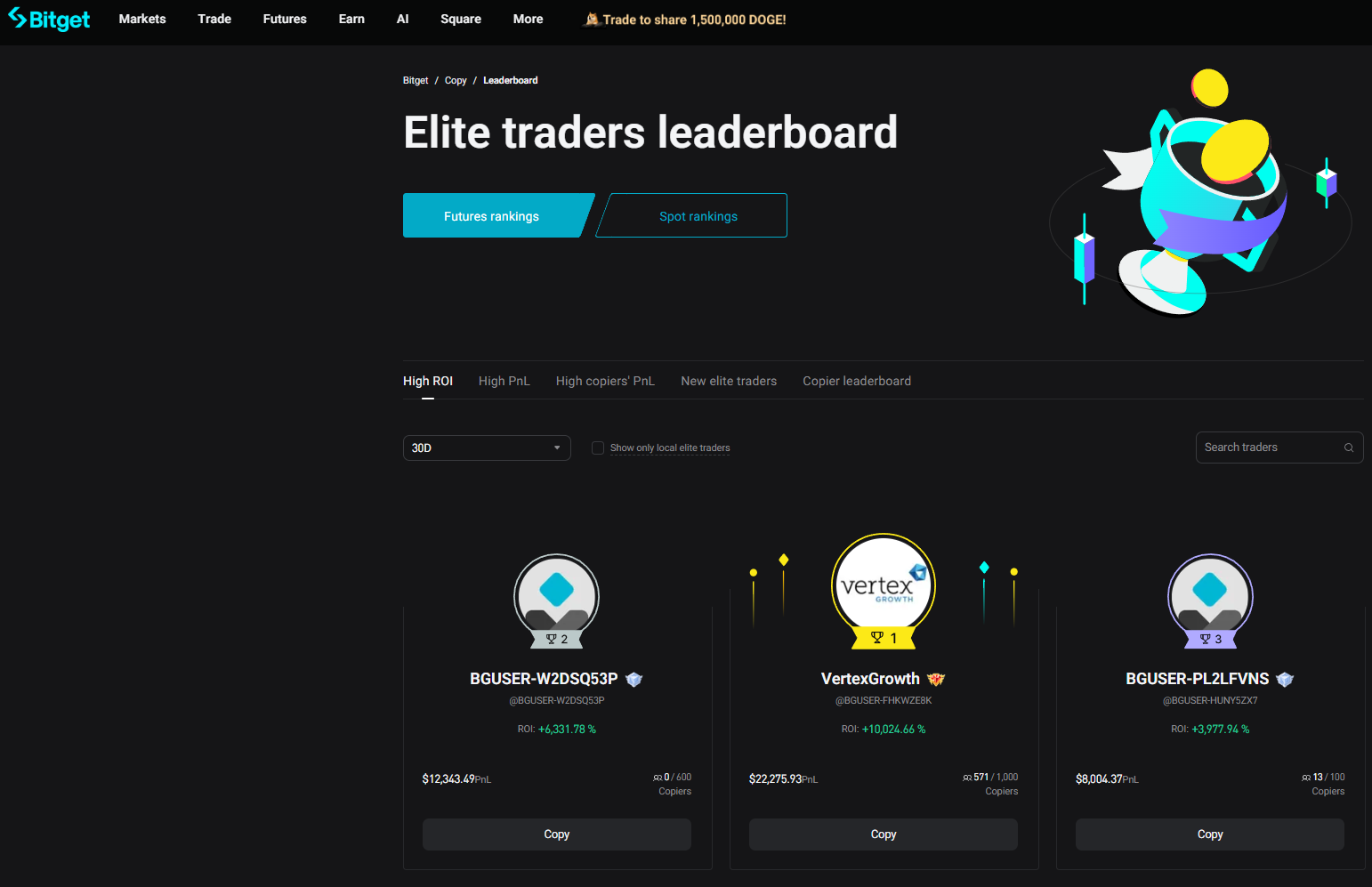
I opened the copy trading page, saw a leaderboard, and sorted by highest ROI. The top trader had something like +3,200% over 60 days. I figured, okay, clearly this person knows what they’re doing. I allocated $900 to copy them (basically half of what I had).
Two days later my $900 was $612. The trader had opened a 50x leverage position on SOL, it moved against them, and my copy got absolutely shredded along with theirs. I remember seeing the red number and just sort of laughing because of course that happened. Of course the person with the insane chart was a gambler who had gotten lucky twice.
I disabled the copy. Opened Reddit. Spent like four hours reading r/Bitget threads and crypto forums to figure out what I should have been looking at instead. That was the night I actually started learning.
What copy trading actually is, without the marketing spin
The basic idea is simple. You browse a list of traders on Bitget, look at their performance history, and pick someone whose style you trust. You allocate money to them. When they open a position, the same position opens in your account at a scaled-down size. When they close, you close. You don’t have to watch anything or press any buttons.
Where it gets more nuanced is that copy trading is not passive income. Every position you copy is a real leveraged futures position in your account with real risk. If the trader takes a 40% drawdown, your allocation takes a 40% drawdown. You’re not investing in a trader, you’re letting them drive your car for a while.
What makes Bitget’s version decent specifically is the amount of data they show you on each trader. You can see their entire trade history, not just summary stats. You can see which pairs they prefer, what their biggest loss was, how many people currently copy them, and how the AUM (assets under management) has changed over time. That last one matters more than people think, and I’ll come back to it.
The trader I picked second (and why it worked)
After my $288 lesson from the first trader, I spent maybe two weeks just watching the list without copying anyone. Every couple of days I’d check the top of the ROI list, note the names, then come back in a week to see how they were doing. Most of them had already blown up or had massive drawdowns by the second check. A few had steady but unremarkable performance.
I ended up copying somebody who at the time had something like a 62% win rate, 14 months of active trading, max drawdown of about 22%, and who used 3-5x leverage on most trades. Their monthly returns were “boring” — usually between 4% and 8%. Nothing that would make a YouTube thumbnail.
That trader has made me $273 in the two months I’ve been copying them. Which might not sound thrilling, but compared to losing $288 in two days on the flashy trader, I’ll take boring all day.
What I actually look for now when I pick traders
Here’s the checklist I run through before copying anyone. None of this is rocket science, but almost nobody new to copy trading actually does it.
| What to check | My rule of thumb | Why this matters |
|---|---|---|
| Trading days active | At least 180 days | Shows they’ve survived at least one market regime change |
| Max drawdown | Under 30%, ideally under 20% | High drawdown means they gamble and got lucky |
| Average leverage | Under 10x | 25x and up is casino territory |
| Win rate | 50%+ is my floor | Consistency beats moonshots for copy trading |
| Current copiers | 100+ is decent, 500+ is great | Other people have already done the due diligence |
| AUM under management | $100K+ is a sign people trust them with real money | AUM draining fast = people know something you don’t |
The last one there is my secret weapon. Check a trader’s AUM trend over the last month. If it’s climbing, copiers are happy. If it’s draining, something changed and the smart money is getting out. I’ve dodged two blowups just by watching AUM before copying.

The fees situation (budget for this)
Nobody told me about the profit share fees until I saw them hit my account at the end of my first profitable week. Here’s how it works on Bitget.
When a trader makes you money, they take a cut, usually 10% of the profit. If a copied trade nets you $50, you keep $45 and the trader gets $5. Losses are entirely yours, which is fair because the trader isn’t going to pay you for losing your own money.
On top of that you pay regular Bitget futures trading fees on every copied trade. These are small, around 0.06% taker and 0.02% maker, but if you’re copying a high-frequency trader who opens 20 positions a day, those small fees eat into your returns faster than you’d think.
Add it all up and if a trader is advertising a “+40% ROI last month,” you’re probably looking at more like 33-35% after fees. Still solid, but set your expectations correctly. Everyone looking at those leaderboard numbers is seeing them before fees.
Set a stop loss before anything else
Probably the single most useful thing I learned in my first month was to always set an auto-disconnect stop loss on every copy.
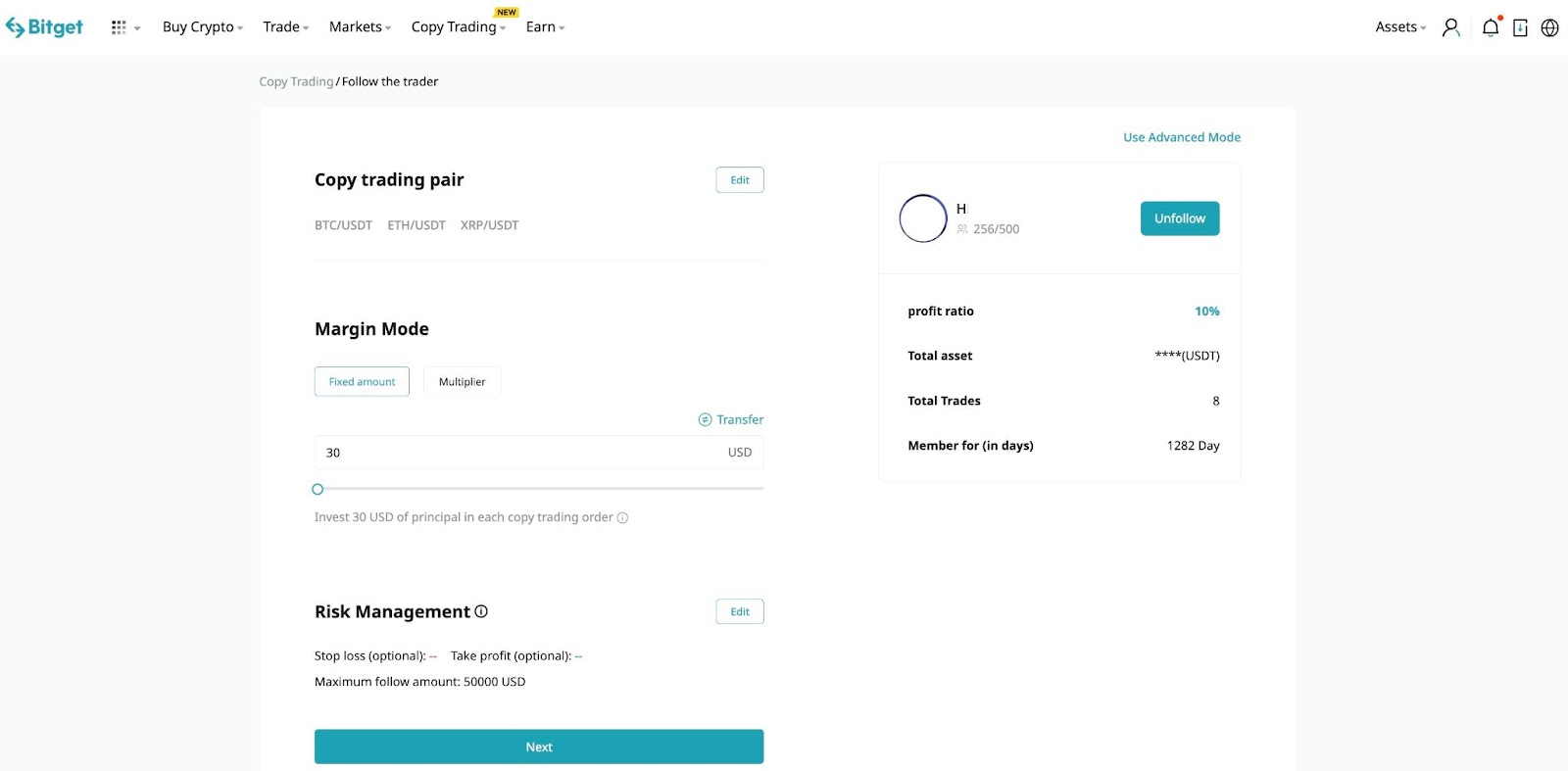
When you start copying a trader, Bitget lets you set a threshold. Something like “if my allocated balance drops below $X, automatically stop copying.” I use 20%. So if I allocate $500 to a trader, the copy auto-cuts at $400.
This saved me once already. Back in March one of my “boring” traders had a bad week, took three losses in a row trying to short a SOL rally, and my stop loss kicked in before they could keep digging deeper. I took about a $90 hit, which stings, but would have been $200+ without the stop loss.
My actual numbers after 3 months
I said I’d share real numbers so here they are. None of these are rounded, none are cherry-picked.
Starting balance: $1,847
Allocated across 3 traders, roughly equal splits of about $615 each. One is the boring swing trader I mentioned earlier. One is a mid-frequency scalper who trades BTC and ETH only. One is a slower position trader who sometimes holds for days.
First trader (swing trader): $615 → $888. Up about 44% over two months. Best performer, lowest stress.
Second trader (scalper): $615 → $597. Basically flat, with fees eating most of the gains. I might rotate out of this one soon.
Third trader (position trader): $615 → $502. Down about 18%. Took a bad bet on a BTC breakout that didn’t happen. Still within my stop loss tolerance so I’m giving them another month before I cut.
Total: roughly $1,987 from $1,847. Up about $140 or around 7.5% over three months. Not life-changing, but better than staring at candles at 3am and worse than my first instinct told me it would be.
Also worth noting — I lost $288 in that first week disaster, which is baked into the total. If I’d been smarter on day one my account would be closer to $2,275 right now.
Three mistakes I still see beginners make
I’m in a few Discord groups now with other copy traders and there are patterns that keep showing up. If you avoid just these three things you’re already ahead of most of the people starting out.
First, putting everything on one trader. Every single person I’ve seen do this has gotten rug-pulled eventually. Even if the trader is good, even a 20% drawdown on your whole account feels like being punched in the chest. Spread across at least three traders with different styles. One slow, one medium, one aggressive if you want, but never all eggs in one basket.
Second, checking the account hourly. I made this mistake for the first month. You’ll see green in the morning, red by afternoon, and you’ll talk yourself into disabling the copy at exactly the wrong time. Now I check maybe twice a week, on purpose. My returns got better the moment I stopped obsessing.
Third, chasing last month’s winner. Someone finishes the month with +60% and suddenly has 2,000 new copiers. Those copiers almost always catch the reversion. By the time a trader is trending, most of their best run is behind them. The AUM growth is often a warning sign, not a green flag, past a certain point.
Some stuff about Bitget specifically
I’ll admit I didn’t do a ton of comparison shopping before picking Bitget. My coworker used it, the signup was fast, the interface made sense, I stayed.
A few months in though, here’s what I’ve actually come to appreciate about it.
The trader data is detailed. You can see every single trade a trader has made for the last year, which is how I caught one trader who was hiding a bunch of losses by opening and closing positions quickly. Their summary stats looked fine, but their actual trade log showed they were basically randomly gambling.
The app works. I know that sounds like a low bar, but if you’ve used some of the other crypto exchange apps you know what I mean. No weird lag, no trades that “technically submitted but didn’t actually go through.” The copy trading settings screen is laid out in a way that makes sense.
The fees are reasonable. Not the lowest in the industry, but low enough that they don’t meaningfully hurt. My scalper trader is the only one where fees really chew into the returns, and that’s a trader selection issue more than a Bitget issue.
The only thing I actively dislike is the leaderboard UI basically encouraging new users to pick the exact worst traders. When you sort by highest ROI, the top is almost always a 50x leverage gambler who got lucky. Bitget knows this. They could hide those traders by default. But from a business perspective they probably get a lot of signups and trading volume from people who chase those numbers.
If I were starting today
Keep it small. Like, $300-500 small for the first month. Even if you have $5,000 burning a hole in your USDT wallet, don’t allocate all of it. Copy trading looks easy when you watch the tutorials, but your first few weeks you’re going to make emotional mistakes. Do them with smaller money.
Copy at least three traders. Ideally five. Diversification is your only defense against one person having a bad week.
Use stop losses on every single copy. No exceptions. Even for your most trusted trader.
Sort the leaderboard by AUM or by trading days active, not by ROI. Ignore the top 20 ROI traders for the first month completely.
Don’t scale up until you’ve been at it for at least a month and have seen both a winning streak and a losing streak. You need to know how you personally react when things go red.
Accept that this is a 3-10% monthly return tool, not a lottery ticket. Anyone promising you otherwise is trying to sell you something.
If you want to try it yourself, the link below is what I used to sign up. Make sure to register through a referral so the beginner bonuses actually show up in your account. I missed out on a chunk of mine because I didn’t know that the first time around.
Good luck out there. If you do it carefully it’s actually a pretty decent way to learn how crypto markets move without having to make all the decisions yourself.
Disclosure: This article contains referral links. If you sign up through these links, I may earn a commission. It doesn’t cost you anything extra, and it helps support writing like this. Thanks if you use them.


GIPHY App Key not set. Please check settings